Thursday, 17 April 2014

Module 3, Chapter 10: Making the accessory

To start with my accessory I collated my previously decorated/coloured fabrics together along with a few new ones that I dyed and printed. I knew that my piece needed to be double sided so I composed them together into two separate but same sized rectangles. I ensured that the size of these were bigger than A3 to accommodate for the extra width I wanted in the spiral shape. I patch-worked the pieces together.

As my favourite technique from the whole project had been free machine embroidery I wanted to use this as my main embellishment onto the fabrics. I first worked back into the spirals that had been created with my print and dye effects. For some of these I simply followed the spiral shapes that were already there with my stitchery and for others I created new spirals within the spirals with a circular motion while stitching.

Once my rectangles of fabric had been constructed and had been free machine embroidery embellished I then 'Bondawebbed' them together so they were back to back- giving me my double sided fabric. I realised that the Bondaweb would not be enough to secure the sides together on their own with any strength so I used the opportunity to add more free-machine embroidery. On this occasion I worked into the spaces between spirals. I was conscious at this stage that anything I did on one side would automatically be visible on the other side so I would do a little stitching then flip the fabric over to do a little more then flip back. To enhance this further I used a blue bobbin with an orange top thread in the machine.

3/10/6: Embellishing my fabrics
The next stage was to cut in my spiral. I debated whether or not to mark out where to cut first, but decided to just take the plunge and go for it! that said I had already practised this a fair bit on plain paper. To see how this all worked as an accessory I then experimented with draping my spiral cut fabric over a mannequin.

3/10/7: Spiral cut fabric draped on the mannequin to see how it looked

I loved the fact I had created not one but endless accessories due to the nature of the variety of possibilities for draping my accessory around the neck. Although I felt that my free machine embroidery looked very effective I decided that my accessory was lacking something so enhanced each side with an additional spiral embellishment. On one side I added an orange pearl bead spiral. I made the point of graduating the bead size for this like I had previously done with my resolved sample for chapter 9. On the other side I used couching (one of my favourite hand embroidery techniques from my earlier hand stitched sampler). For the couching I used a yarn with a blended colour effect. I have to admit on reflection that I could have made a little more of this particular spiral- maybe I could have started the spiral a little tighter? Could I have composed it so that it would have been a little more dramatic? Was it too subtle? Maybe I could have embellished it further with a few beads? For both of these embellishments I once again had to be very conscious that what ever I was adding to one side would affect the other side.

Even with these new spirals I felt that the piece lacked something. I was also discovering at this stage that where I had cut the spiral (and after handling the piece quite a lot) that the edges were starting to come apart. I decided to use a hand applied blanket stitch around the edges to hold them together and give a contrast edging. The benefit of doing this is that I ended up enhancing the spiral effect, most notably when the piece was being stored flat. My final piece is as follows showing a few variations and possibilities for draping over the mannequin:

3/10/8: My final accessory
 

3/10/9: My final accessory close up views


Module 3, Chapter 10: Design an accessory- initial ideas

To collect some initial ideas for my accessory I looked back at all my previous work and reflected on some of the images and samples I had worked with to see if they brought to mind any specific types of accessories:


3/10/1: initial thoughts for accessory

 
Two particular accessories came to mind- some kind of head piece/hat and some kind of neck piece such as a collar, scarf or necklace. At this stage I decided to gather some ideas from the Internet to help consider possibilities for shape and style:
 

3/10/2: hat and headpiece accessory research

3/10/3: neck accessory research


I decided at this stage that I was feeling far more inspired by the neck accessories. I had thoughts of creating a spiral piece that could wrap around the neck and perhaps fall into further spirals but was unsure how to do this. I started to create some mini spirals out of paper and card to generate some ideas. I quickly realised that both sides of the paper/card would be visible and therefore equally important for embellishment so I developed my spirals further using my decorated and coloured papers and photographing them from different angles:

3/10/4: Card spiral experiments

I really liked the fact that there were so many different possibilities with the way these shapes could be arranged and thought this would translate really well into a neck accessory that could be worn in different ways. To test this out I tried out a range of different sizes in plain paper and then arranged them around a mannequin to see how they could look. I also experimented with the spiral shape and proportions. I finally settled on a spiral cut out of paper that was approximately A3 in size. The results of just a small selection of my draping possibilities with this are as follows:

3/10/5: Paper spiral draping
At this stage I knew this was the direction I wanted my accessory to go in although I realised that for my final piece I would like the width to be a little larger so I would need to ensure my fabric starting shape was larger than A3 to accommodate this.

Sunday, 23 February 2014

Module 3, Chapter 9: Resolved sample

After receiving some very constructive feedback from Sian, I took a fresh look at the ideas I had for my resolved sample. I decided to take Sian's advice and let the sample develop as I progressed through the process of making it. The first thing I did was to select one of my previously printed samples as a background for a suitable starting point. I chose to embellish this background further with a little free machine embroidery stitching to enhance the mono-printed spiral on there:


3/9/1
3/9/1

I wanted to then add some spirals across this background using another mono-printed sample from a similar colour scheme/fabric choice. I wanted the contrast to be in the scale of the pattern rather than in a difference of colour:

3/9/2
3/9/2


 After cutting out a number of different spiral shapes and playing around with a variety of composition ideas I attached the spirals using free machine embroidery in spiral motions:


3/9/3
3/9/3
 
 
3/9/4
3/9/4


I next wanted to add a spiral that contrasted with this background. I came across a block printed sample that had been created onto a piece of orange chiffon fabric. I initially attached it to the backing using a spiral motion free machine embroidery stitch along the printed line. The result was not as pleasing as I hoped so I thought I would experiment by cutting away and fraying the fabric in between the spiral print. This worked a treat as it added a new texture dimension to the piece and allowed the spiral print from the backing underneath to show through effectively.


3/9/5
3/9/5
 

3/9/6
3/9/6

 
I then decided that my blue spirals did not show up as much as I had hoped- they were too subtle. To resolve this I edged each one using hand embroidered chain stitch. I gave the centre where the spirals focused around a new focal point with a hand painted embellishment to create a button of sorts. This had the optical illusion of giving depth to the spirals.


3/9/7
3/9/7

 
Once I saw the depth the 'button' gave, I felt that the orange spiral now looked too flat. To enhance it and to make more of a 3D effect I decided to hand stitch on two additional orange spirals out of beads. I deliberately chose not to follow the line of the original orange spiral as I wanted the effect to be more chaotic rather than ordered and predictable. Finally, I mounted the sample over a robust rounded corner square paper plate. This has given the final result an even bigger effect of depth. Unfortunately my photography does not do this any justice! I did play with the idea of having spirals coming out on wires around the piece as Sian had suggested as a possibility, however I felt the spirals distracted from what I wanted to be my focal point of the piece: the orange spiral. The following images show my final resolved sample piece, including close ups of some of the detail on there:

3/9/8: Final resolved sample


3/9/9
3/9/9
3/9/10
3/9/10

Saturday, 4 January 2014

Module 3, chapter 9: initial thoughts for resolved sample

Before I start creating ideas in paper towards my sample, I thought it would be good to look back at some of my previous work to see if I could identify any possibilities for composition. I have created the following ideas which are cropped areas of other work. At this stage the colours, techniques and textures are irrelevant, I just wanted to see how I could use/place a spiral onto my sample. Pictures 9-12 are from samples of varying descriptions. The ideas that stand out the most for me and that I feel I will expand through to my paper compositions are 5, 7, 9, and 11. This is mainly because they are all very different to each other but have potential to have more interest added with layers and stitchery.


3/9/1a
3/9/1a

3/9/1b

Module 3, chapter 8: bead sampler

This was the most time consuming sample to date- it took considerably longer to create than I predicted, something to take into consideration when using beads in the future. I also found it challenging to work with the tiny beads. I ended up buying some specialist beading needles. These however came with their own challenges as they were impossible to thread without a needle threading tool, but these kept breaking on me to the point I only used a fraction of the small seed and bugle beads I had intended on putting on there!

I did not have a plan when starting this sample, other than to try and create a spiral on top of a tie-dyed piece of fabric as I went along. Interestingly the end result resembles a shell design. I aimed to have contrasts at each point, either through size or colour or texture/appearance. I also tried different patterns and spacings along the way. If I had more time (and to be honest more patience!) I would have experimented more with different combinations, such as having a sequin sewn under a seed bead. I would have also tried edging effects as suggested in the chapter notes.

Note that I tried stitching on other components too, such as buttons, sequin waste, painted screws and mini 'gems'.


3/8/1: Bead sampler
3/8/1: Bead sampler
3/8/2: Bead sampler- close up of centre


3/8/3: Bead sampler- close up


3/8/4: Bead sampler- close up


3/8/5: Bead sampler- close up


3/8/6: Bead sampler- close up


3/8/7: Bead sampler- close up


3/8/8: Bead sampler- close up.
The main beads used here are glow in the dark! I have been unable to get a decent photo of them glowing however. I deliberately sewed them on in a way that there are two spirals formed, one with beads on their side, the other with the beads on their back.

Module 3, Chapter 7: Simple button making

The most surprising thing about this chapter was that the buttons although they look really simple actually were more complex and time consuming to make than I expected! As a result I was unable to produce as many as I hoped to as I have been really time poor in recent times.

I decided to mount them onto a dark blue background as this to me showed off their colours and shapes to the best effect. I have included some close up views on some of the buttons.

I particularly enjoyed creating the more experimental ones- fusing fibres in mini cellophane parcels.


3/7/1: buttons
3/7/1: buttons


3/7/2: Woven button
3/7/2: Woven button (would have been more successful if I had considered how to fasten off the edges!)
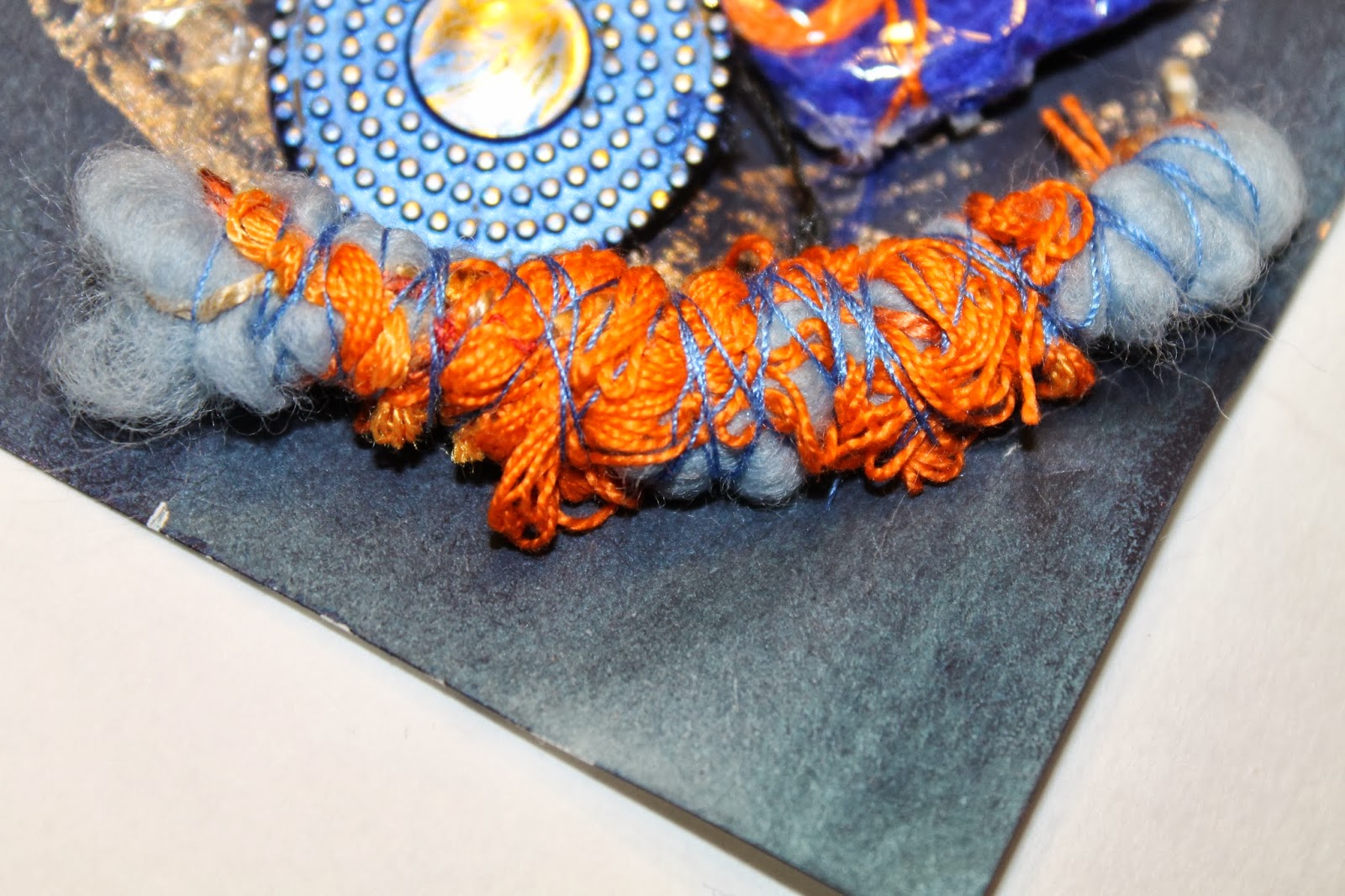
3/7/3: Fabric, thread and beads wrapped button


3/7/4: Wool tops wrapped button

Note that above it is a random disc button created by painting a component cut from another item. I thought it looked 'button like' so included it alongside my samples.


3/7/5: yarn wrapped button
3/7/6: Fused cellophane button

Module 3, Chapter 6: Simple tassels


3/6/1: simple tassels


3/6/2: experimental tassels
3/6/2: experimental tassels
The following images show the tassels I created for this chapter. I made the point of experimenting with a wide variety of threads and yarns especially through thickness and texture.

Personally I found the finer and smoother/shinier the yarn the more I liked the tassel. I also enjoyed securing tassels with stitchery on my machine as this added a wonderful extra embellishment to the overall effect.

The first picture shows my more basic tassel samples. For the middle row I deliberately chose contrasting yarns for effect.

The second picture shows my more experimental tassel samples. I tried using different textures such as fabric strips or wool tops. Most of these have been secured with machine stitching.

The photos that follow are close ups of a selection of the tassels showcased in the first two photos.


3/6/3: Fine thread tassels
3/6/3: Fine thread tassels
3/6/4: Tassels with stitchery
3/6/4: Tassels with stitchery


3/6/5: tassels with contrasting textures
3/6/5: tassels with contrasting textures